A denser liquid can support the same floating object while the object displaces less liquid volume. The object’s mass has not disappeared, and gravity has not switched off. A simple worked example helps explain the physical support associated with a salt-water float, while leaving personal suitability and any claims about health to their own evidence.
The description of feeling light in water can otherwise suggest that something happened to the person rather than to the balance of forces. Everyday language is useful for describing a sensation, but a literal explanation needs a different vocabulary. Begin with liquid displaced and upward force, rather than interpreting “weightless” as a measurement.
The upward force comes from the displaced liquid
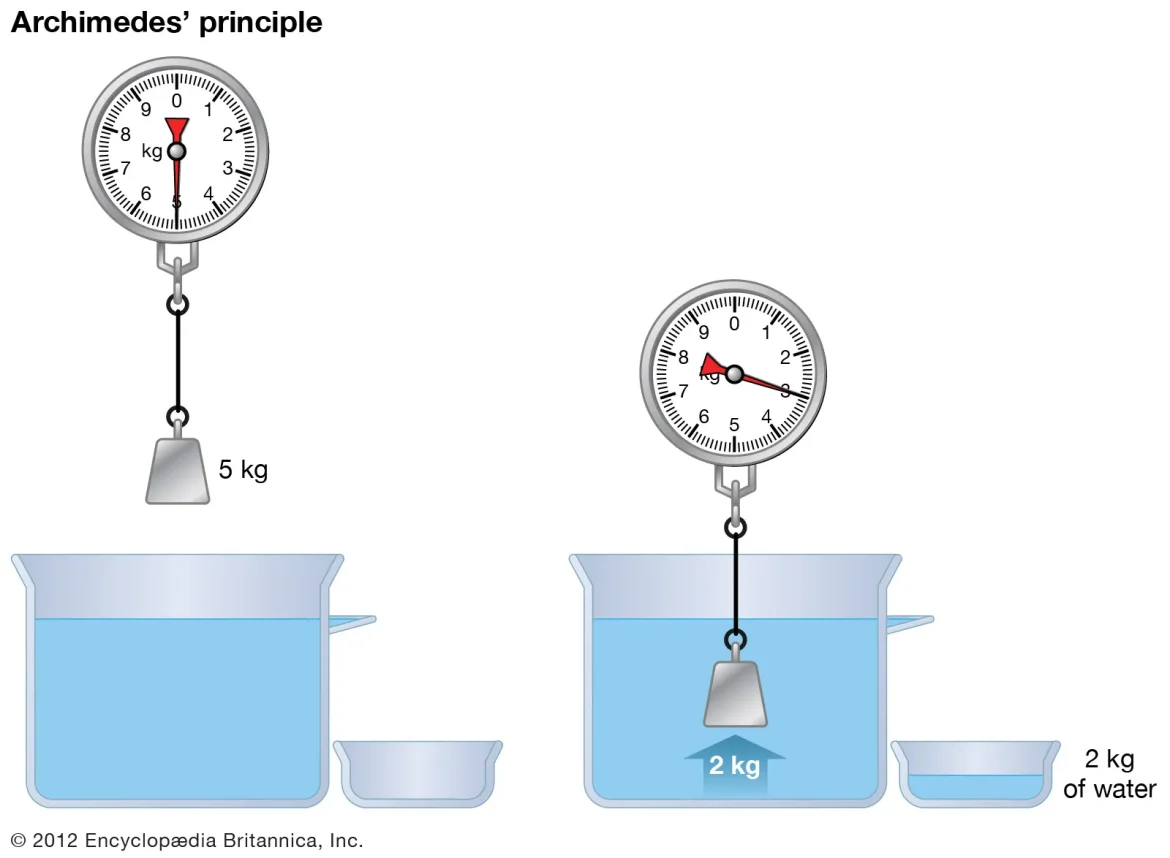
OpenStax’s explanation of Archimedes’ principle relates buoyant force to the weight of the displaced fluid. Water pressure increases with depth, so pressure around an immersed object produces a net upward force. For a freely floating object at rest, that support balances the object’s weight.
Displacement refers to the volume occupied by the immersed part of the object. It is not necessarily the entire object’s volume. A floating object can project above the surface while its immersed portion displaces the amount of liquid needed to balance its weight. Keeping those two volumes distinct is essential to the comparison.
A local example provides the setting rather than the calculation’s measurements. Santé Healing Spa’s published flotation description identifies pink Himalayan salt in an open-concept tank in Thornhill. The following figures are original hypothetical values for a rigid object, not measurements of that tank, its water or a guest.
Think of density as mass for a given volume. A litre of a denser liquid has more mass than a litre of a less dense one. For the same displaced volume, the denser liquid therefore provides a larger buoyant force. A floating object can reach the required balance with less of its volume immersed.
Notice the comparison being made. We are holding the object fixed and changing the liquid. If we also changed the object’s mass, shape or volume midway through the example, we would lose the clean explanation of what the liquid’s density contributes. A controlled imaginary comparison is easier to follow than two unrelated holiday photographs.
Keep the same object while changing the liquid
Suppose a sealed, rigid object has a mass of 6 kilograms and an external volume of 8 litres. Place it in a hypothetical liquid with a density of 1 kilogram per litre. To float at rest, it must displace liquid whose weight equals its own. In this shared gravitational setting, that means displacing 6 kilograms of liquid.
At 1 kilogram per litre, those 6 kilograms occupy 6 litres. The object’s immersed portion therefore occupies 6 litres, or three-quarters of its total 8-litre volume. There is enough external volume for it to float partly above the surface under the simplified assumptions of the example.
Now put the same object in a second hypothetical liquid with a density of 1.2 kilograms per litre. The object still has a mass of 6 kilograms. It still needs to displace liquid with the same 6-kilogram mass to balance its weight. But 6 divided by 1.2 is 5, so the required displaced volume is now 5 litres.
That is 62.5% of the object’s external volume, compared with 75% in the first liquid. The displaced volume has fallen by one litre. Nothing has been removed from the object, and the example has not assigned it a new body weight. The change is in how much liquid volume supplies the balancing support.
The unit calculation is useful: kilograms divided by kilograms per litre gives litres. If a calculation produces kilograms when you are trying to find displaced volume, something has been mixed up. Keeping the units beside the numbers makes the reasoning easier to check without adding a second complicated formula.
These fractions concern volume, not the percentage of an object’s height visible above water. Shape determines how volume is distributed vertically. A broad, flat shape and a narrow upright shape can displace the same number of litres with different surface positions. Do not turn the volume result into a predicted photograph.
The example also does not establish stability in a particular orientation. Balancing upward support and weight explains one part of floating; it does not supply every detail about how an object will sit or move. Keeping the model’s limits clear prevents a useful calculation from becoming a claim it was never designed to support.
A physical explanation leaves the service decision open
A human guest is not the rigid object used above. Do not enter your weight into this example to predict a body position, choose an immersion technique or decide whether a venue is suitable. Follow the venue’s actual orientation and obtain appropriate professional advice about individual concerns rather than designing a personal float from a classroom calculation.
Likewise, understanding buoyancy does not establish a health outcome. A physical mechanism for upward support is different evidence from research about a particular clinical claim. One should not be used to bypass the other simply because both appear in a description of the same service.
There is also no home mixing recipe hidden in the arithmetic. The hypothetical densities were chosen to make the calculation transparent, not to specify a salt concentration or an operating target. A commercial treatment environment involves arrangements that this example has not described or assessed.
The useful result is an intelligible scene: the object retains its weight, the liquid supplies upward support and greater liquid density changes the volume that must be displaced. That explanation can travel with your curiosity about floating without becoming a personal promise about what the appointment will achieve.